

COMMERCIAL BRANDING · 2026
Business Car Wrap Ideas That Actually Bring In Customers
A branded vehicle is the cheapest advertising you will ever buy, but only if the design survives being read at 30 mph. Here is what works in 2026, by industry, with previews you can generate on your own van before anything gets printed.
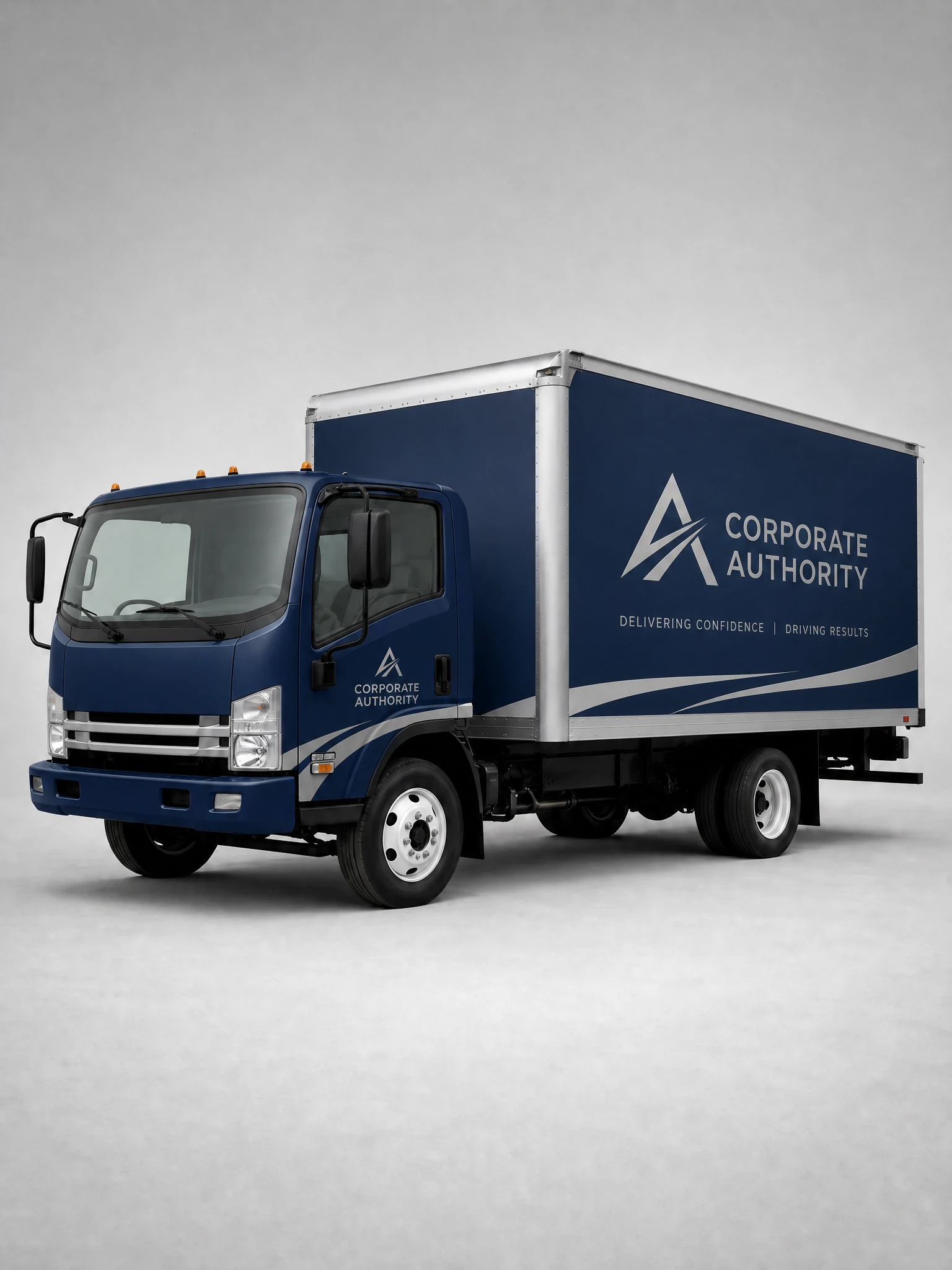
Why a wrapped work vehicle pays for itself
A wrapped work vehicle is the only advertising you pay for once and then keep for years. It drives past the same neighborhoods every single day, it parks in front of the job you are already doing, and unlike a billboard it follows your actual service area.
The catch: a commercial wrap is printed once. If the phone number is unreadable, if the logo sits over a door seam, or if the color looks nothing like the sample on screen, you find out after the film is on the panel. That is why the workflow below starts with a photorealistic preview on your vehicle. See the vehicle wrap customizer for how the preview itself works, and the truck wrap design generator for van and box-truck layouts.
THE MISTAKE THAT COSTS THE MOST
You are designing for a moving billboard, not a business card
Most business wraps fail for one reason: they were designed on a laptop at 100% zoom, where every line is legible. On the road a driver has roughly 4 to 6 seconds and needs to catch exactly three things: what you do, your name, and how to reach you. Everything else is decoration.
The five rules every business wrap has to follow
These are the rules wrap shops apply before they draw anything. Break them and the design can still look beautiful in a portfolio while generating no calls at all.
RULE 1
One message per side
Pick the single thing you want remembered, such as Emergency plumbing, 24/7, and let it own the panel. A list of nine services reads as zero services.
RULE 2
Contrast beats color
Dark text on light film, or light text on a genuinely dark film. Mid-tone on mid-tone disappears in overcast light, which is most of the year in most places.
RULE 3
Phone number bigger than the logo
Your logo builds recognition over years. The number generates a call today. On a work van the number should be the second-largest element on the vehicle.
RULE 4
Respect the panel gaps
Door handles, fuel flaps, sliding-door tracks and body seams cut straight through artwork. Keep critical text inside flat, uninterrupted areas.
RULE 5
Design the rear first
The rear of the vehicle is what people stare at in traffic for minutes at a time. It earns more attention than both sides combined, so put the offer there.
BY INDUSTRY
Business car wrap ideas that are working in 2026
Nine directions, each one a different answer to the same question: what should a stranger conclude about your business in five seconds?
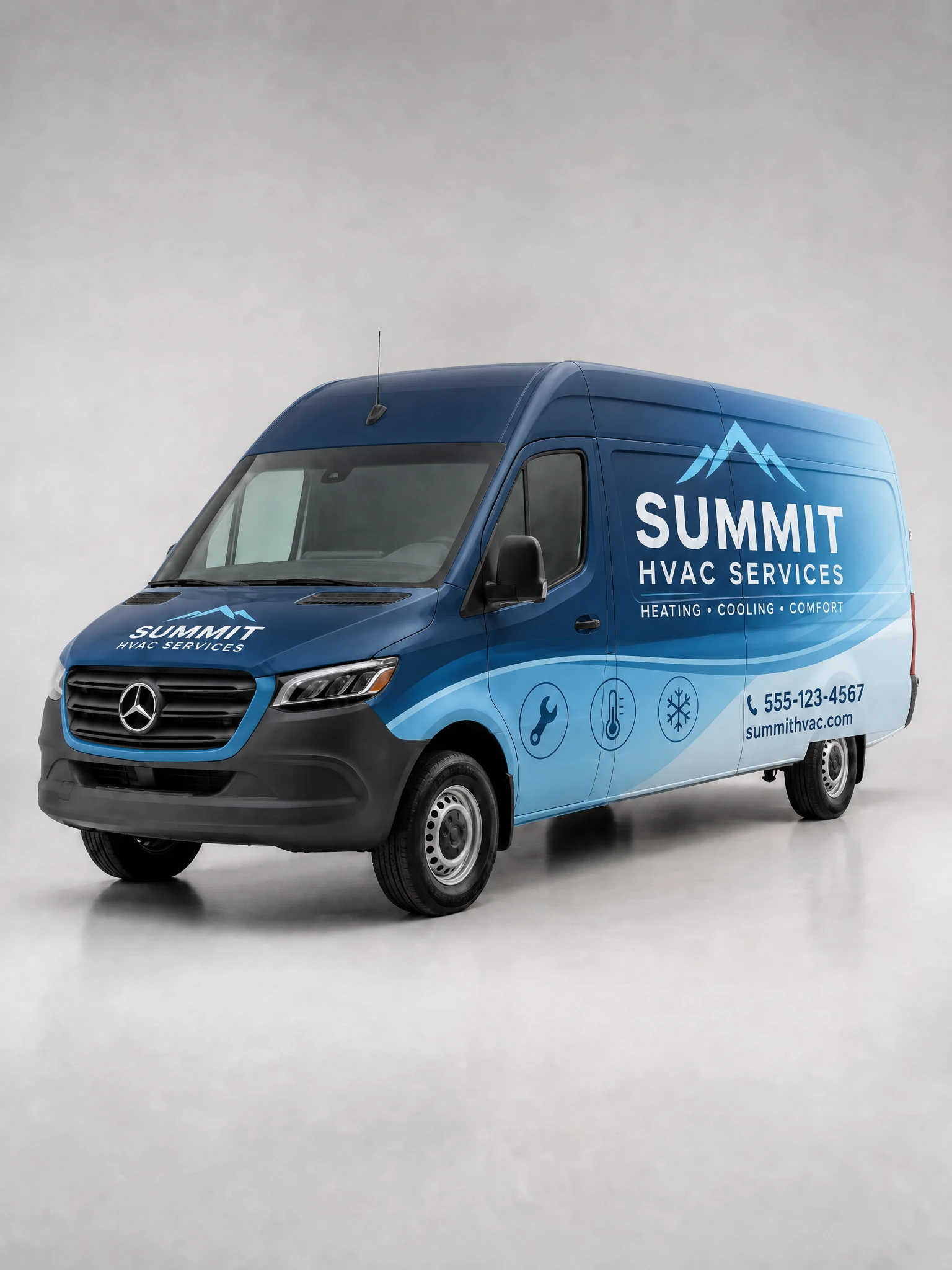
A single diagonal sweep from a dark base into your brand color. Reads as established and licensed rather than improvised, and it hides the panel seams that ruin busier layouts.
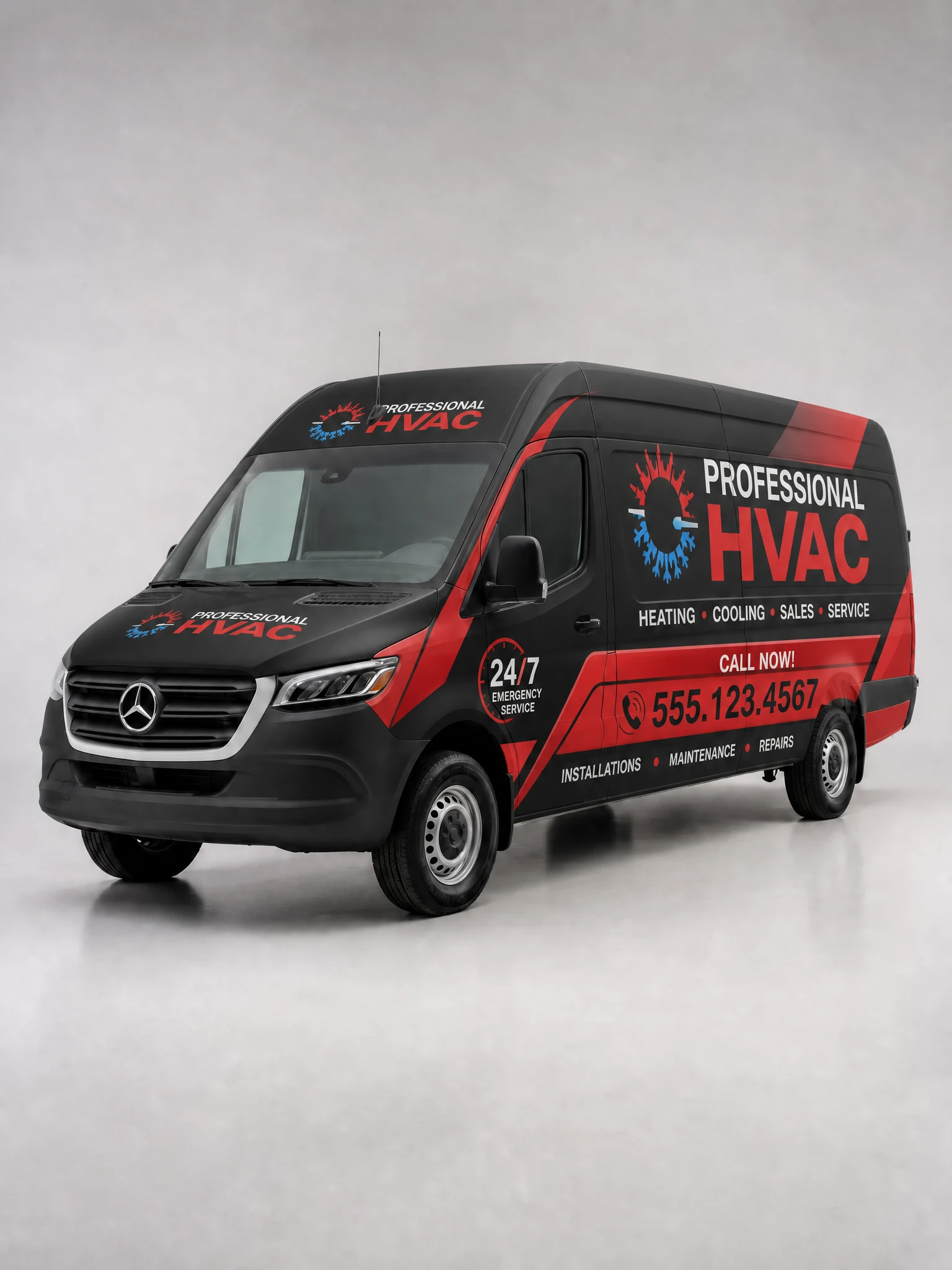
The whole design exists to make one phone number impossible to miss. Ideal for any trade where the customer is calling in a hurry and will not go looking for a website.
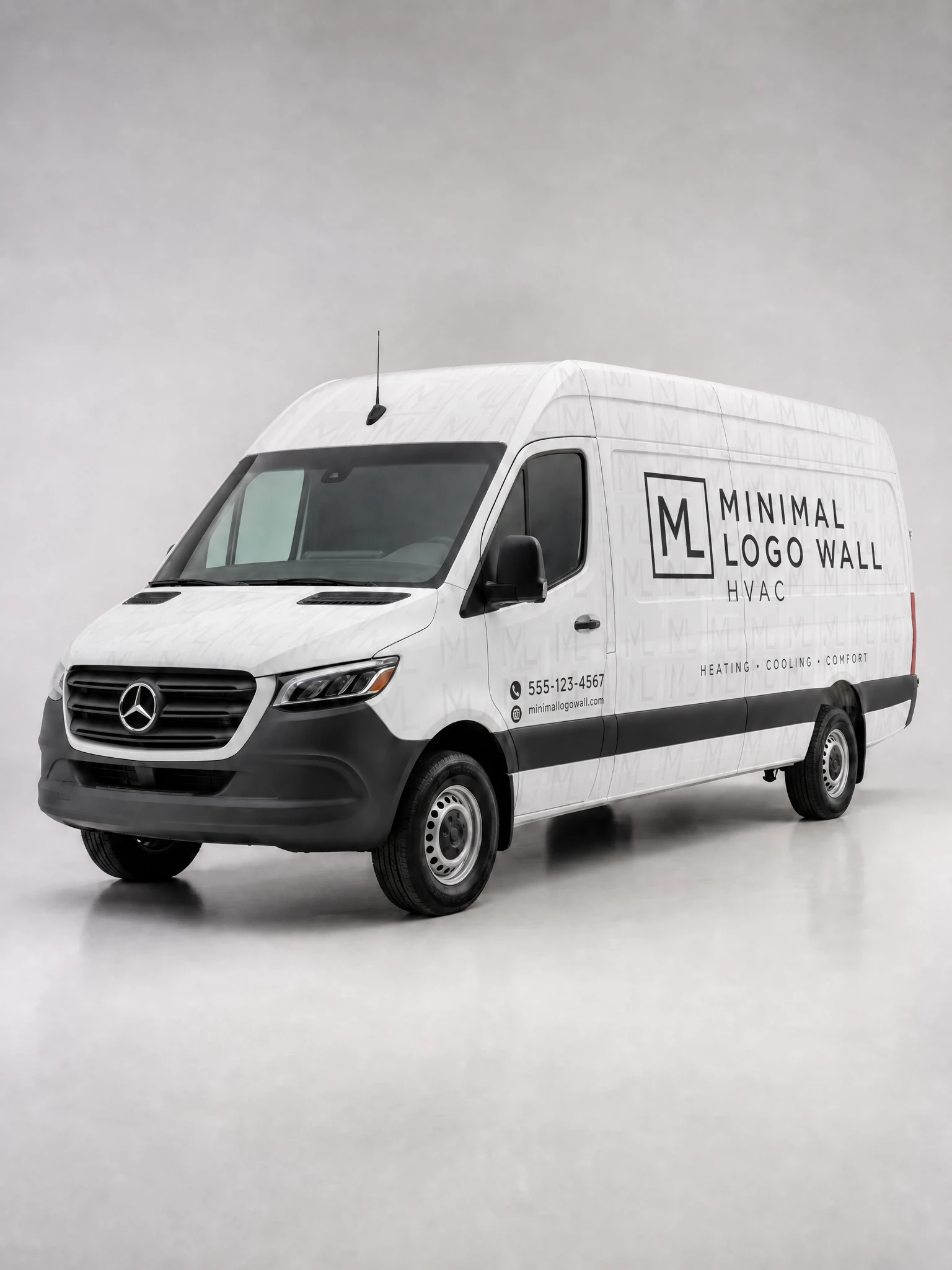
Manufacturer approvals and trade-body badges along the lower third. In B2B the logos are the argument: they answer are you allowed to touch our equipment before anyone asks.
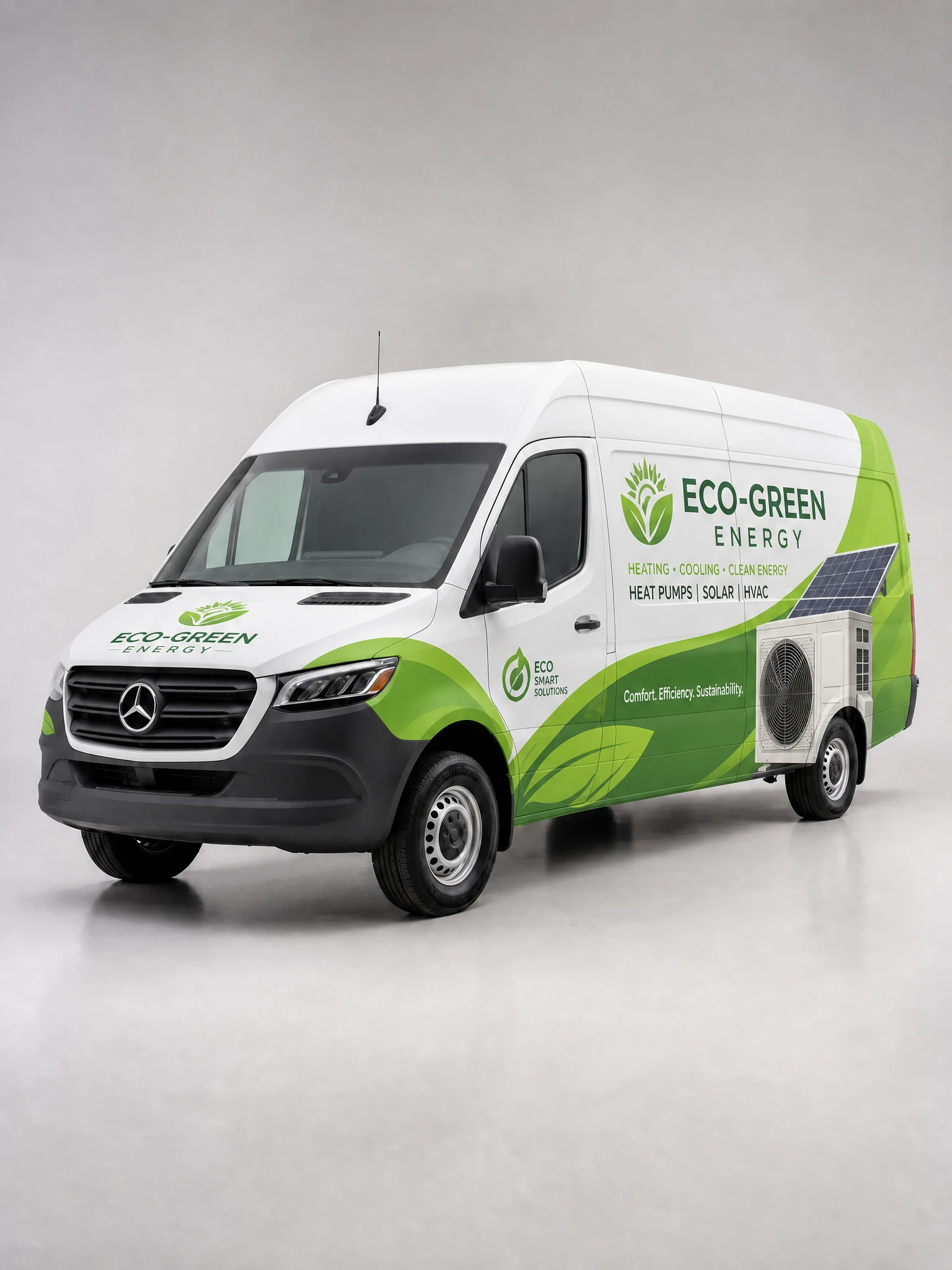
Green film alone says nothing any more. Pair it with one concrete number, such as installed capacity, tons diverted, or years in business, and it stops being a color choice.
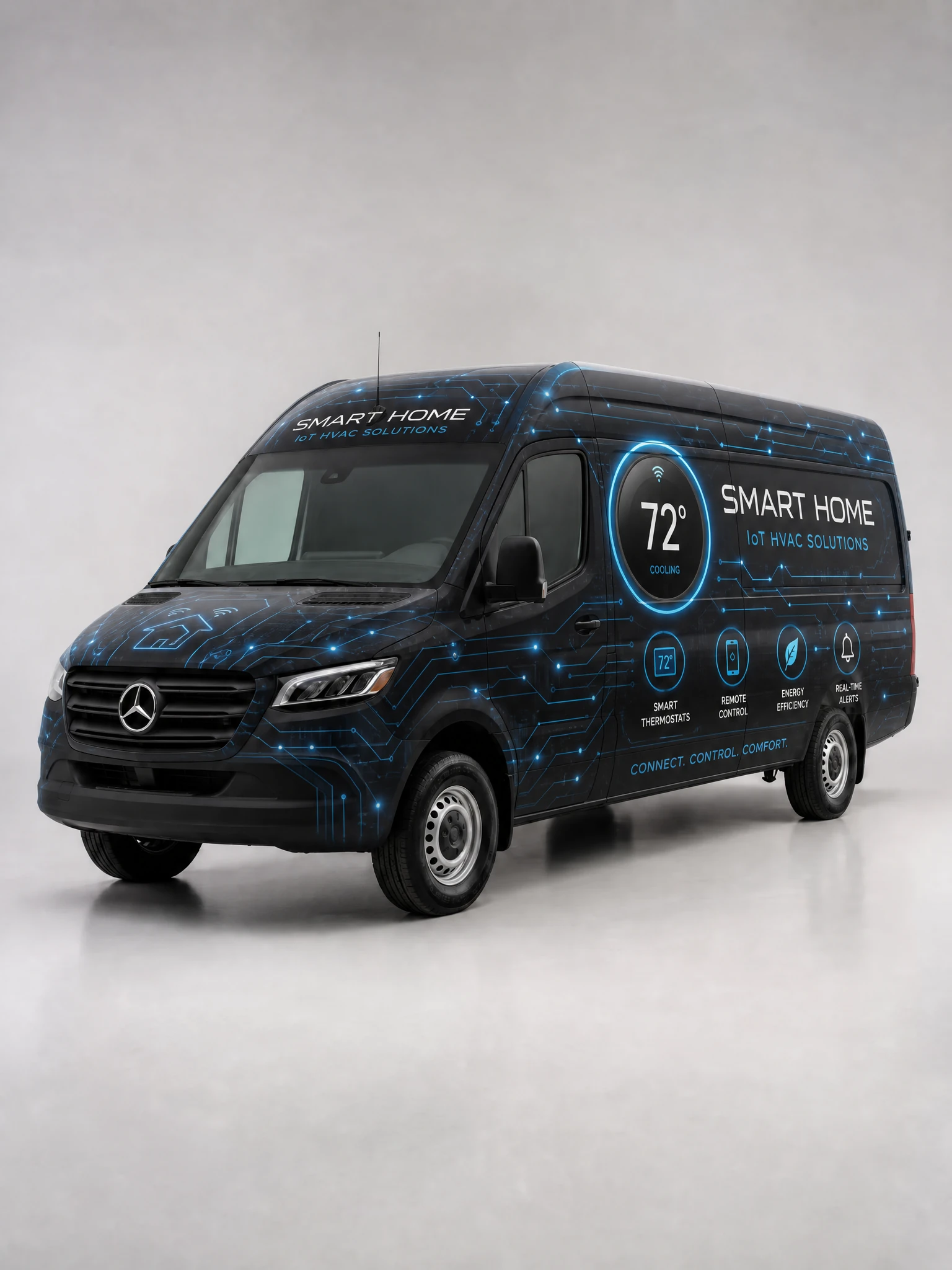
Thin-line circuitry or node graphics on a dark base, kept to a background layer. Signals competence for technical trades without turning the van into a stock illustration.
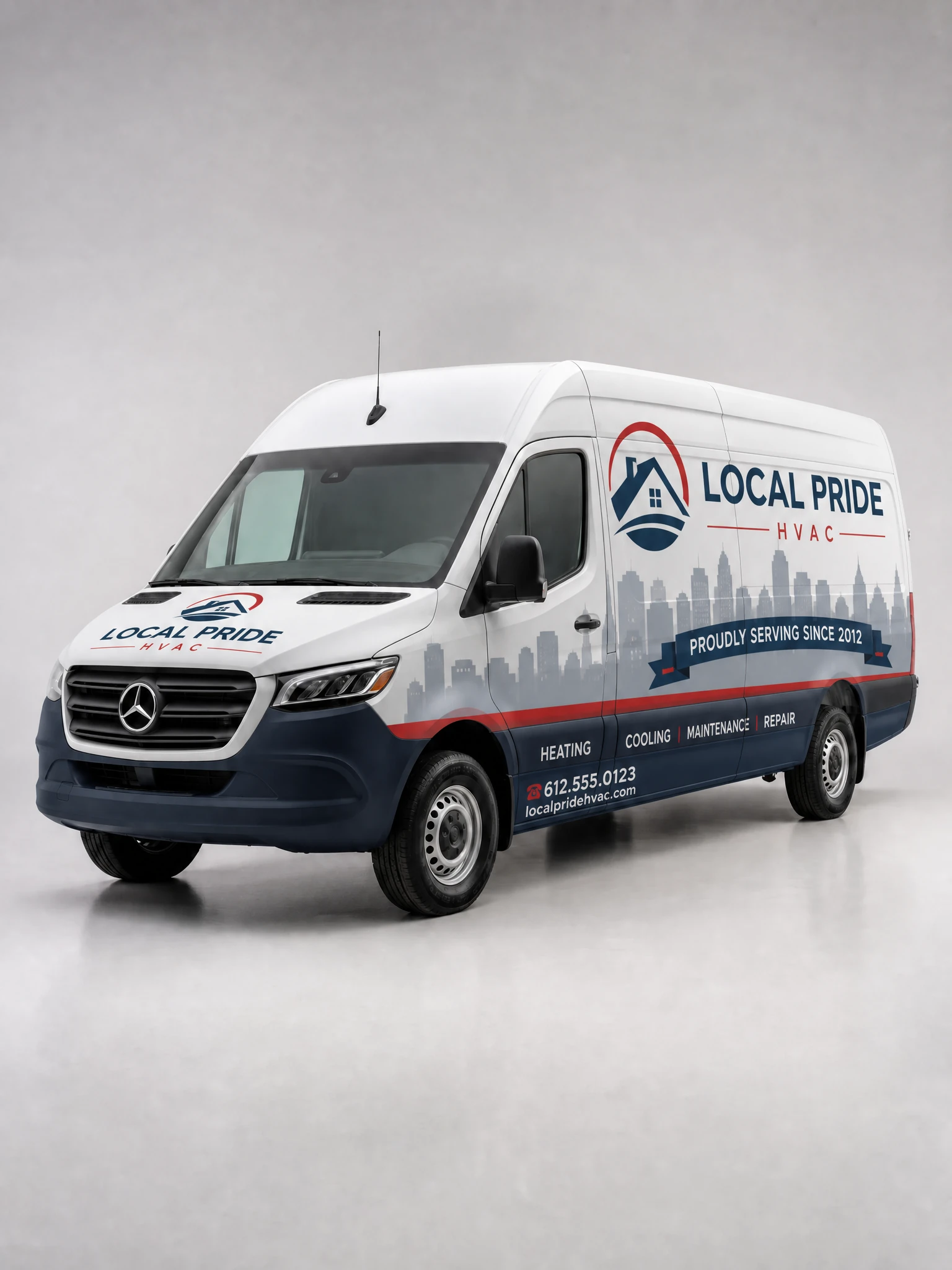
A recognizable skyline, district name, or serving the area since line. Converts unusually well for trades chosen on trust rather than price.
The safest choice at fleet scale: one strong color, one layout, applied identically to every vehicle. Three matching vans read as a company, three different vans read as subcontractors.
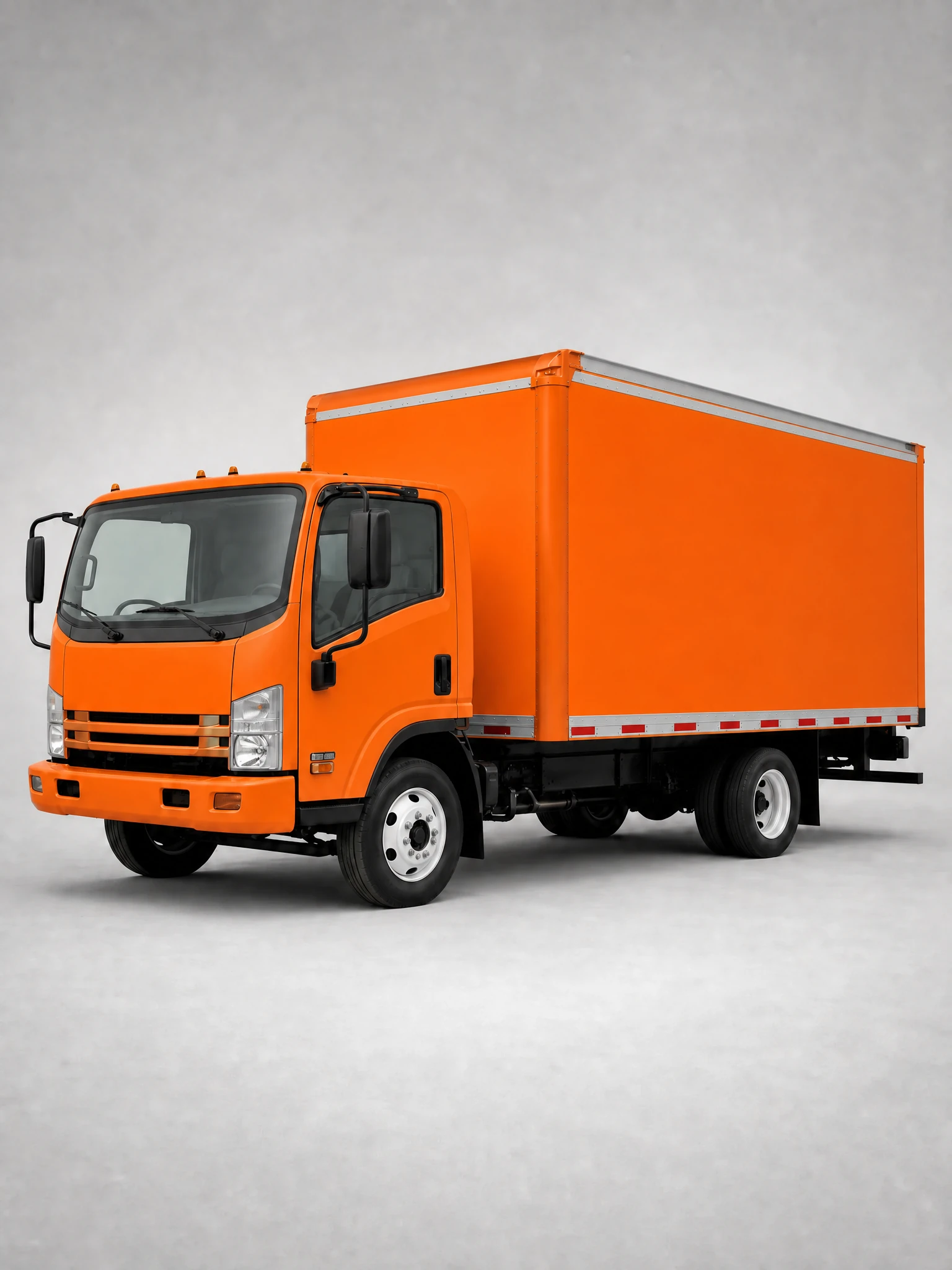
Where the vehicle parks in live traffic, visibility is a working requirement first and branding second. Check local rules on reflective film and chevron patterns before printing.
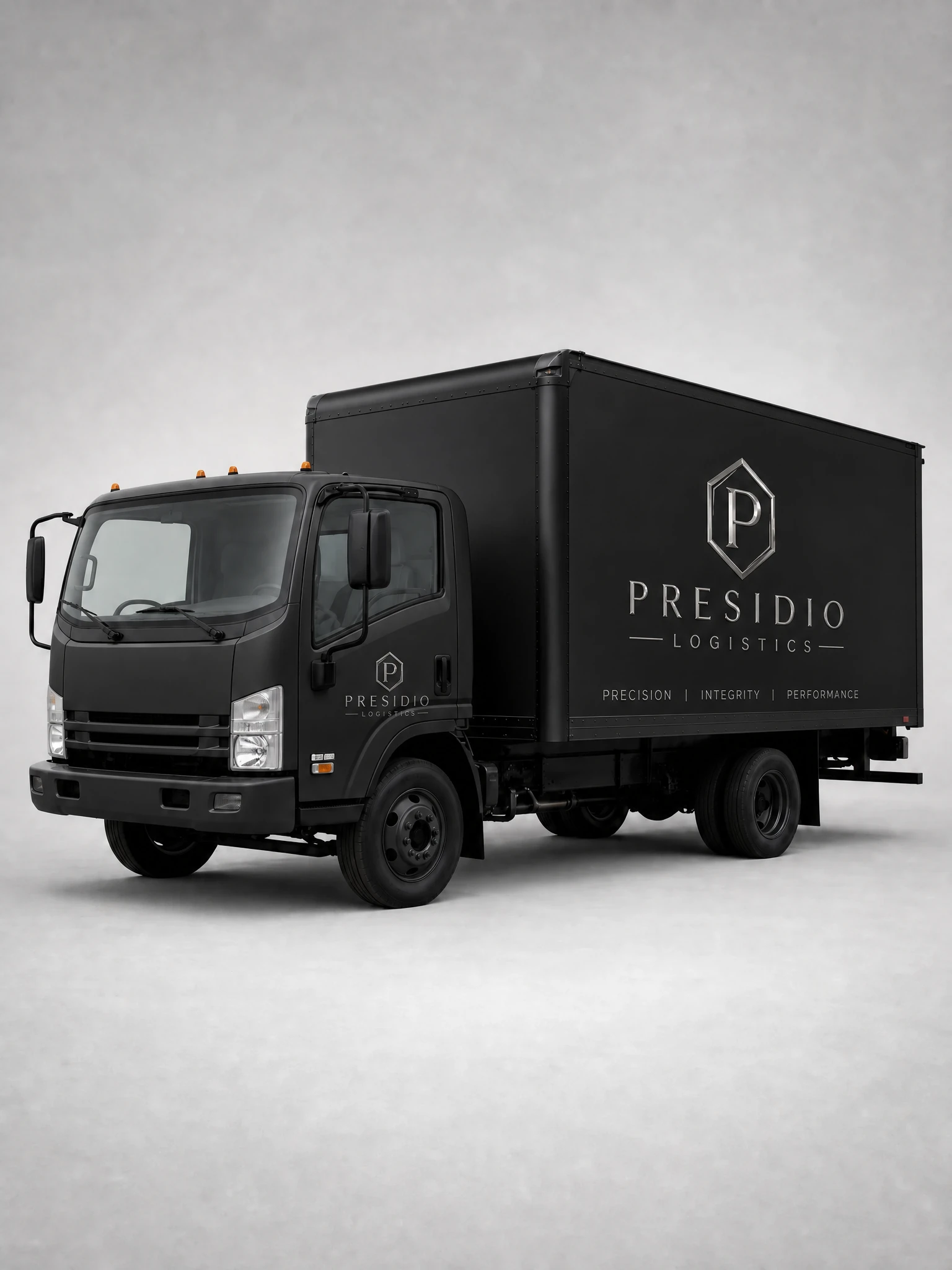
Small satin logo, no phone number, no service list. Works only when clients already come by referral. It says discretion, and it says the van is not looking for walk-ins.
Full wrap, partial wrap, or just decals?
Coverage is the biggest single lever on cost, and most businesses over-buy it. The rear-plus-sides partial gets the majority of the impressions at a fraction of the film.
| Option | What it covers | Best for | Trade-off |
|---|---|---|---|
| Full wrap | Every painted panel, color change included | Fleets, rebrands, protecting resale paint | Highest film and labor cost |
| Partial wrap | Rear plus the lower two-thirds of both sides | Most single-vehicle businesses | Base paint color has to work with the design |
| Decals / lettering | Logo, number, service line only | Leased vehicles, tight budgets, quick tests | Reads as a marked car, not a branded one |
| Rear window only | Perforated film on the rear glass | Adding an offer to an existing wrap | Small canvas, one message maximum |
Practical points that decide the outcome
- Leased vehicles. Cast film on factory paint removes cleanly within its rated life. Confirm the lease terms in writing anyway, and keep the film inside its service window, because removal gets expensive once it is over-aged.
- Cast, not calendared. Vans are full of rivets, recesses and compound curves. Cast film (3M 2080 and 1080, Avery Supreme, KPMF, Hexis) conforms; cheap calendared film lifts at every edge inside a year.
- Print then laminate. A printed commercial wrap without an over-laminate fades and scuffs from washing. The laminate is not an upsell, it is the reason the wrap still looks new in year four.
- Washing. Hand wash, no pressure washer close to the seams, no aggressive solvents. Matte and satin finishes in particular pick up polish marks permanently.
- Repeatability. If you will ever add a second vehicle, keep the source artwork and the exact film references on file. Matching a wrap two years later without them means reprinting the whole set.
BEFORE YOU PRINT ANYTHING
See the design on your own vehicle first
Upload a photo of the actual van, not a stock template, and generate the wrap on it. You will catch the problems that only appear on a real body: text crossing a door seam, a logo swallowed by the sliding-door track, a color that goes flat in your local light. Signing up takes a minute and includes 3 free generations, with no credit card.
Frequently Asked Questions
1. How much of the vehicle should a business wrap actually cover?
For most single-vehicle businesses, the rear plus the lower two-thirds of both sides captures nearly all of the useful attention. Full coverage makes sense for fleets, for rebrands, and when you also want the film protecting the resale paint.
2. What should be on a work van, website or phone number?
Phone number, larger. A website is a second step the driver behind you will not take. Put the number where it is readable from three car lengths and keep the domain short and secondary.
3. Will a wrap damage the paint or affect my lease?
Quality cast film on intact factory paint removes cleanly within its rated service life, and it shelters the paint underneath while it is on. Get the lease terms confirmed in writing, and do not leave the film on past its rated life.
4. How long does a commercial wrap last?
Five to seven years for premium cast film with an over-laminate, less in harsh sun or if the vehicle is pressure-washed frequently. Horizontal surfaces such as the roof and hood always age first.
5. Can I wrap a fleet gradually instead of all at once?
Yes, and it is the normal approach. The requirement is to keep the source artwork and the exact film references so vehicle five matches vehicle one. Without those, matching later means reprinting the whole set.
6. Do dark or light wraps work better for business vehicles?
Neither on its own, because contrast is what matters. Dark film with light text and light film with dark text both work. Mid-tone artwork on a mid-tone base is what disappears in overcast light.
7. Are there legal restrictions on commercial vehicle graphics?
Rules vary by country and city, and they mostly concern reflective film, chevron markings, emergency-service-like color schemes, and covering windows or lights. Check locally before printing, especially for high-visibility designs.
8. Can I test several designs before committing?
That is the point of previewing on a photo of your own vehicle. Your first 3 generations are free after signing up, so you can put two or three directions side by side, look at them outdoors on a phone, and only then send artwork to print.
Design your business wrap before you pay for film
A commercial wrap is printed once and lives on the vehicle for years. Spend ten minutes seeing it on your actual van first.
3 free generations after signup • No credit card • First result in under 10 seconds